Article
Feb 10, 2026
GEO: The New Frontier of Discoverability In an AI-First World
As AI systems increasingly replace search results, brand discoverability is no longer just about rankings. This article introduces Generative Engine Optimization (GEO): a new discipline focused on how brands are understood, trusted, and represented in AI-generated responses.
For years, search acted as the primary gateway between brands and customers. Visibility was straightforward: rank well, get discovered. If you didn’t, you invested more in content, optimization, and distribution until you did.
That model is now fundamentally changing.
AI systems increasingly answer questions directly. Instead of presenting a list of links, they generate a single, synthesized response; deciding which brands to mention, how to describe them, and which alternatives to include or exclude entirely.
In this environment, discoverability is no longer determined by rankings alone. It depends on whether AI systems understand, trust, and choose to represent a brand at all.
This shift has introduced a new discipline: Generative Engine Optimization (GEO).
What is GEO?
Generative Engine Optimization (GEO) is the practice of managing how a brand appears in AI-generated answers.
While traditional SEO focuses on helping webpages rank, GEO ensures that a brand exists accurately, consistently, and contextually within the synthesized answers provided by AI.
SEO vs. GEO: Understanding the Difference
SEO and GEO address different layers of discoverability. One is not replacing the other, but they are optimizing for fundamentally different systems.
SEO was built for retrieval; surfacing the right link. GEO is built for interpretation; synthesizing information into a cohesive response.
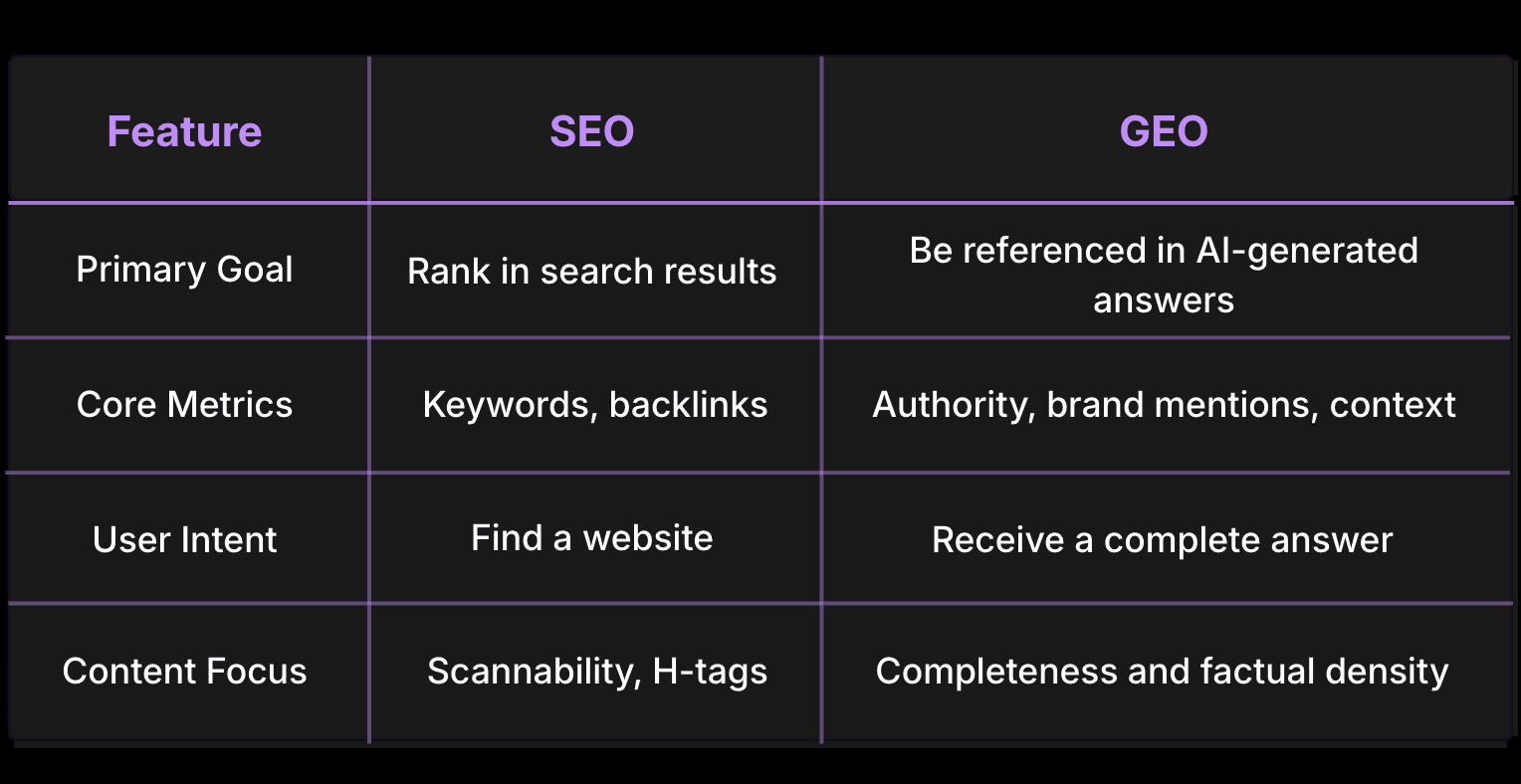
A brand can perform exceptionally well in SEO and still be invisible in AI responses, not because SEO failed, but because it was never designed to control how information is summarized, compressed, and presented.
That gap is exactly where GEO operates.
How AI Systems Decide Which Brands Appear
When a generative engine produces an answer, it does not rely on a single page or source. It assembles responses based on patterns learned across a broad set of inputs.
Over time, each brand becomes an “internal summary” inside the system. That summary is shaped by signals such as:
Consistency of brand descriptions across sources
Presence of credible, third-party references
Frequency of appearance in relevant contexts
Clarity and differentiation of positioning
Recency and authority of coverage
If those signals are weak, fragmented, or outdated, AI systems fail to form a reliable summary. Brands are either omitted entirely or misrepresented.
Three Pillars of a Successful GEO Strategy
Effective GEO strategies are built around how AI systems interpret, validate, and prioritize information. In practice, this means strengthening the signals generative engines rely on when deciding what to trust.
1. Optimize for Interpretability and Synthesis
Generative engines do not read content line by line. They infer meaning from structure, repetition, and relationships across sources.
A strong GEO foundation ensures that a brand’s digital presence is:
Structurally clear
Semantically consistent
Closely associated with defined topics and use cases
When signals are coherent, AI systems can reliably synthesize the brand into relevant answers.
2. Reinforce E-E-A-T Across the Ecosystem
Generative engines evaluate information using long-standing trust signals: Experience, Expertise, Authoritativeness, and Trustworthiness (E-E-A-T).
For enterprises, this extends far beyond owned content. AI systems look for:
Subject-matter experts consistently cited across platforms
Executive voices appearing in credible third-party contexts
Alignment between brand claims and external validation
When E-E-A-T signals are reinforced across the broader ecosystem, not just on a website, AI systems are far more likely to treat the brand as a reliable reference point.
3. Address Complex, Decision-level Questions
AI-driven discovery is rarely triggered by simple keywords. Users increasingly ask layered questions that reflect real business problems, trade-offs, and constraints.
Effective GEO strategies focus on content that:
Responds to multi-part, high-intent queries
Reflects how decisions are actually evaluated
Positions the brand as a solution architect
This is where generative engines naturally surface brands that demonstrate clarity, depth, and authority.
Looking Ahead
The shift toward AI-generated answers is already reshaping how brands are discovered. Managing that visibility will soon be as foundational as managing search performance, analytics, or brand governance.
Maxeo exists to make this new layer of discoverability visible and actionable: helping organizations understand how their brand appears in AI-generated answers today, and how to improve that representation over time.
Begin your AI discoverability journey with our free visibility report →
Take Control of Your AI Presence Now
Start your AI visibility journey with our free report
Get free report
Get free report